Evaluating the Addiction Recovery Steps Vector Template for Professional Design
Visual communication plays a critical role in healthcare education, particularly when addressing complex and sensitive topics like substance abuse treatment. The Addiction Recovery Steps Vector Template serves as a specialized design resource intended to streamline the creation of educational materials, presentations, and informational brochures. For professionals in counseling, public health, or graphic design, selecting the right visual asset requires understanding not just the aesthetic appeal, but the functional utility and technical specifications of the template. This evaluation explores how this specific vector infographic template aligns with professional needs, examining its structural components, format versatility, and appropriate use cases.
Defining the Asset and Its Core Components
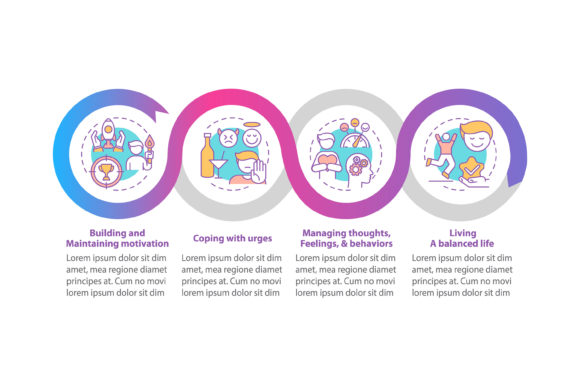
The Addiction Recovery Steps Vector Template is a pre-designed graphical framework that visualizes the progression of recovery through structured data visualization. Unlike generic medical icons, this template is specifically engineered to map the psychological and behavioral journey of addiction treatment. It typically integrates an emotions presentation outline alongside clinical milestones, acknowledging that recovery is both a medical and emotional process.
The core architecture of this template usually features a 4-step process timeline info chart. This four-stage structure often corresponds to recognized phases such as acknowledgment, detoxification/stabilization, active therapy, and maintenance/aftercare. By limiting the visualization to four distinct nodes, the template avoids cognitive overload, making it suitable for patient-facing materials where clarity is paramount. The design employs a workflow layout with line icons, utilizing clean, minimalist strokes rather than heavy, filled illustrations. This stylistic choice reduces visual noise and maintains a professional, clinical tone appropriate for healthcare environments.
Technical Versatility and File Format Considerations
A primary factor in evaluating any digital design asset is technical compatibility. The availability of multiple file types—JPG, EPS, PNG, SVG, and AI—significantly impacts the template's long-term value and workflow integration.
- AI (Adobe Illustrator) and EPS: These are the source files essential for customization. They allow designers to alter colors to match organizational branding, adjust typography, or modify the timeline steps if a specific program uses a five or six-step model. Without these vector formats, the template is merely a static image with limited utility.
- SVG (Scalable Vector Graphics): This format is crucial for web-based applications. As healthcare providers increasingly move intake forms and educational resources online, SVG ensures the infographic remains crisp on all screen sizes without increasing page load times excessively.
- PNG and JPG: These raster formats serve immediate needs for non-designers. A counselor creating a quick PowerPoint slide or a social media manager posting an awareness update can utilize these files without needing specialized vector software. However, users must understand that these formats do not support editing of individual elements.
When comparing this template to others, verify that the vector layers in the AI/EPS files are organized logically. Poorly layered vector files can negate the time-saving benefits of using a template, as untangling grouped elements often takes longer than designing from scratch.
Benefits of Structured Visual Communication
The decision to adopt a standardized template like the Addiction Recovery Steps Vector Template often stems from the need for consistency and efficiency. In multi-disciplinary teams, ensuring that psychologists, case managers, and marketing staff present a unified message is challenging. A centralized visual template establishes a standard vocabulary for discussing recovery stages.
Furthermore, the inclusion of data visualization with 4 steps transforms abstract concepts into tangible milestones. For patients and families, seeing recovery mapped out visually can reduce anxiety by providing a predictable framework. From a production standpoint, the workflow layout with line icons offers high legibility at small scales, making it effective for printed handouts, business cards, or mobile app interfaces where space is constrained. The balance between emotional resonance and clinical structure helps bridge the gap between empathetic care and evidence-based practice.
Tradeoffs and Limitations
Despite its utility, the Addiction Recovery Steps Vector Template presents inherent tradeoffs that evaluators must consider. The most significant limitation is the rigidity of the four-step model. Addiction recovery is non-linear, and many clinical models utilize different frameworks, such as the Transtheoretical Model (Stages of Change) which includes six stages, or chronic disease management models that emphasize cyclical rather than linear progression. If your organization’s methodology does not align with a four-step linear timeline, forcing content into this template may result in oversimplification or clinical inaccuracy.
Additionally, the reliance on line icons, while aesthetically modern, may lack the warmth required for certain audiences. Some community outreach programs find that hand-drawn or illustrative styles resonate better with vulnerable populations than sleek, corporate-style vector art. There is also the risk of ubiquity; because vector templates are widely distributed, there is a possibility that other organizations in your region may use identical graphics, potentially diluting your brand identity. Customization via the AI or EPS files is necessary to mitigate this risk, requiring access to both software and skilled personnel.
Situational Fit: When to Choose This Template
This template is a strong fit for specific operational contexts. It is ideal for initial intake orientations, where providing a clear, high-level overview of the treatment roadmap helps set expectations. It is equally effective for grant proposals and stakeholder reporting, where funders require concise visual summaries of program logic and outcomes. Educational workshops for family members also benefit from this structured approach, as it provides a scaffold for understanding the recovery ecosystem without overwhelming attendees with jargon.
The template also serves well in digital marketing funnels for treatment centers. The process timeline info chart functions effectively as a scroll-stopping element on landing pages, quickly communicating value and structure to prospective clients researching options. In these scenarios, the professional polish of the vector artwork conveys competence and trustworthiness.
When Alternatives Are Worth Considering
Evaluators should look beyond the Addiction Recovery Steps Vector Template when the communication goal diverges from structured education. For narrative storytelling or testimonial campaigns, photography or custom illustration often carries more emotional weight than a diagrammatic workflow. If the content focuses on harm reduction rather than abstinence-based recovery steps, a linear timeline may be conceptually inappropriate, and a circular or network-based visualization would be more accurate.
Furthermore, if your team lacks access to Adobe Illustrator or similar vector editing software, purchasing a template that relies heavily on AI/EPS customization may be a poor investment. In such cases, seeking templates specifically designed for Canva or PowerPoint, or commissioning a custom designer to deliver final raster assets, may offer a better return on investment. Finally, for highly specialized clinical training aimed at medical professionals, generic templates may lack the necessary depth and annotation capabilities found in academic or peer-reviewed visualizations.
Making the Final Selection Decision
Ultimately, the decision to utilize the Addiction Recovery Steps Vector Template should be based on an alignment between the asset’s structural constraints and your organization’s communicative goals. Assess whether the 4-step data visualization accurately reflects your clinical model. Evaluate your internal capacity to modify AI and EPS files to ensure brand differentiation. Consider whether the line icon aesthetic matches the tone of your audience engagement strategy.
By treating this template as a foundational tool rather than a finished product, professionals can leverage its efficiency while maintaining clinical integrity. The availability of diverse formats from SVG to JPG ensures broad applicability across print and digital channels, provided the user understands the technical requirements of each. When selected thoughtfully, this vector infographic template bridges the gap between complex clinical realities and accessible public understanding, supporting the broader mission of effective addiction education.