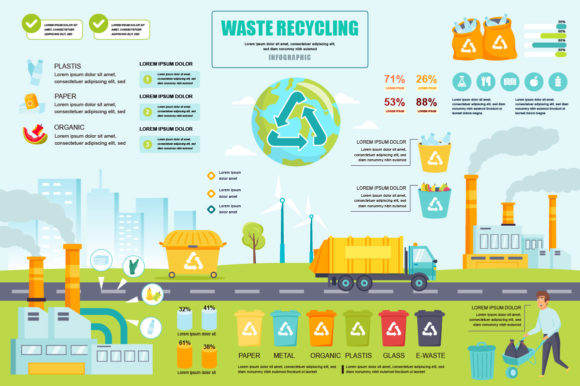
Waste Recycling Infographic Template: A Practical Guide to Visualizing Industrial Processes
Communicating the complexities of waste management requires more than just text; it demands clear, structured visual storytelling. A Waste Recycling Infographic Template serves as an essential bridge between technical industrial data and public understanding. Whether you are designing a poster for a municipal recycling program, creating educational materials for students, or presenting workflow analytics for a sorting facility, these templates provide the foundational structure needed to convey information efficiently. The value lies not just in the aesthetic appeal of vector illustrations but in the pre-organized logic that guides the viewer through timelines, workflows, and graphic data visualization without requiring you to build a layout from scratch.
Professionals and creators often seek these resources to save time, yet many encounter frustration because they approach the selection process with misconceptions about file compatibility and editability. Understanding what this template actually offers—and where its limitations lie—is the first step toward producing high-quality environmental communication materials. This specific asset includes a comprehensive suite of files: EPS10, AI, PDF, JPG, PNG, and SVG formats within an editable text ZIP package. Recognizing how to leverage each format correctly prevents common workflow bottlenecks that can derail a project before it begins.
Avoiding Compatibility and Software Version Errors
One of the most frequent mistakes designers make when downloading vector assets is assuming universal backward compatibility. While this template provides an EPS10 file, which is widely regarded as a safe standard for older software, users with outdated versions of Adobe Illustrator or alternative vector editors like CorelDRAW or Affinity Designer may still experience issues. A common error occurs when opening the AI file in a version significantly older than the one used to create it, resulting in missing gradients, broken mesh tools, or uneditable text boxes.
To avoid this, always check your software version against the file specifications before purchasing or downloading. If you are using open-source alternatives like Inkscape, rely on the SVG or EPS10 versions rather than the native AI file. The SVG format included in this package is particularly valuable for web-based infographics or users who do not have access to proprietary Adobe software. Overlooking the SVG option forces non-Adobe users to attempt risky conversions that often degrade the quality of the industrial recycle process plant illustrations. By selecting the appropriate file format for your specific ecosystem, you ensure that the garbage sorting icons and workflow arrows remain crisp and fully manipulable.
The Editable Text Misunderstanding
Many buyers assume that "Editable Text" means every single label in the infographic will be immediately ready for typing. However, in complex industrial designs featuring detailed machinery or process flows, some text elements may be outlined or embedded within grouped objects to preserve the design integrity during transfer. A practical correction to this expectation is to inspect the layers panel immediately upon opening the file. If text appears unselectable, it may be nested inside a clipping mask or a compound path.
Rather than recreating the text manually, use the direct selection tool to navigate the layer hierarchy. This template’s inclusion of both AI and EPS formats allows you to cross-reference; sometimes text remains live in the AI file but becomes outlined in the EPS export. Always prioritize the native AI file for heavy editing. If you must use the PDF version for quick edits, be aware that font substitution can alter the spacing of your timeline or data visualization elements. Keeping a backup of the original fonts or utilizing the outlined text as a tracing guide ensures your final output maintains professional typographic standards.
Evaluating Visual Accuracy in Industrial Representation
When dealing with niche topics like industrial recycling plants, generic clip art often fails to represent the actual process accurately. A significant oversight is choosing a template based solely on color scheme while ignoring the semantic accuracy of the illustrations. For example, confusing single-stream sorting visuals with multi-stage industrial separation processes can mislead your audience and undermine your credibility as an educator or industry professional.
Before committing to this Waste Recycling Infographic Template, scrutinize the preview images to ensure the depicted machinery and workflow steps align with your specific narrative. Does the graphic data visualization support the type of metrics you need to display? If your focus is on plastic recovery rates, but the template emphasizes organic composting timelines, the structural mismatch will require extensive redesign work, negating the time-saving benefits. A better approach is to map out your content requirements first, then verify that the template’s existing nodes, connectors, and icon sets can accommodate your data without forcing unnatural layouts. The goal is to enhance clarity, not to force your unique industrial data into an irrelevant visual metaphor.
Resolution and Format Selection for Different Media
Another area where efficiency is lost involves using the wrong file format for the intended output medium. Using the high-resolution JPG or PNG included in the ZIP file for print production is a critical error. These raster formats are excellent for web previews, social media sharing, or digital presentations, but they lack the scalability required for large-format posters or banners. Pixelation at print size destroys the professional look of intricate vector line work.
Conversely, sending a massive AI or EPS file to a client who only needs to view the concept on a mobile device creates unnecessary friction. Practical advice dictates a strict separation of assets based on end-use:
- Print Production: Use the AI or EPS10 files to maintain vector sharpness for banners and posters.
- Digital/Web: Utilize the SVG for responsive scaling or the PNG for transparent backgrounds in slide decks.
- Client Proofing: Send the flattened PDF or JPG to prevent unauthorized editing while ensuring consistent viewing across devices.
By respecting the distinct purpose of each included file, you streamline your delivery process and maintain quality control across all platforms.
Customization Beyond Color Swapping
Beginners often limit their customization to changing the primary colors to match brand guidelines, leaving the default icons and layout density untouched. This superficial editing results in generic-looking materials that fail to engage the target audience. To truly maximize the utility of this template, you should treat the provided elements as a modular system rather than a static image. The industrial recycle process plant graphics and garbage sorting icons are typically separated into layers or groups.
Take advantage of this modularity by rearranging components to fit your specific story. If your workflow has four steps instead of six, delete the excess nodes and redistribute the remaining elements to maintain visual balance. Do not feel obligated to keep every decorative element if it clutters the message. Effective data visualization prioritizes cognitive ease over decoration. Furthermore, consider updating the iconography to reflect modern recycling technologies if the template’s vintage aesthetics do not match your current industrial context. Combining the template’s robust layout structure with updated, relevant visuals creates a custom asset that feels bespoke rather than stock.
Checking Licensing and Usage Rights
Finally, never overlook the legal and ethical dimensions of using digital assets. Assuming that purchasing a template grants unlimited rights for all applications is a dangerous assumption. Before integrating this Waste Recycling Infographic Template into commercial products, merchandise, or large-scale public campaigns, review the specific license terms associated with the download. Some licenses restrict usage to personal projects or limit the number of impressions for commercial advertising.
Additionally, verify whether the template requires attribution. While many premium assets do not, failing to credit the original creator when required can lead to copyright disputes. For educators and non-profits, checking for extended educational licenses can sometimes provide broader usage rights at a lower cost. Being diligent about licensing protects your organization from liability and supports the creators who maintain these valuable design resources. By combining technical proficiency with visual accuracy and legal awareness, you transform a simple download into a powerful, professional communication tool that effectively advances the conversation around sustainable waste management.