People with Disability Support: Visual Design Guide
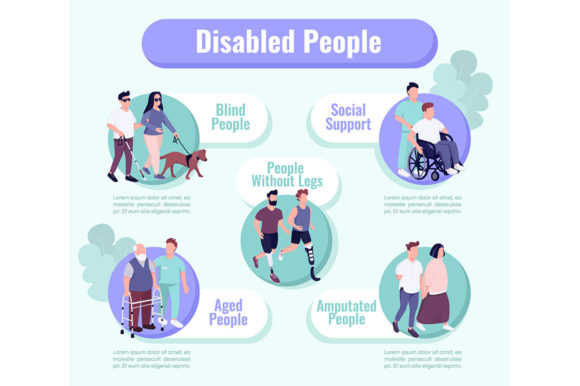
Effective communication in the social services sector requires a delicate balance between professionalism and approachability. When designing materials for People with Disability Support, the visual language must be inclusive, clear, and dignified. Flat color vector infographic templates offer a unique solution to this challenge. Unlike photorealistic imagery, which can sometimes feel intrusive or overly specific, flat vector art provides a universal aesthetic that focuses on concepts rather than individual identities. This style allows designers, educators, and advocates to present complex information about accessibility, rights, and care services in a format that is instantly digestible and emotionally resonant.
The utility of a comprehensive template pack lies in its versatility. Whether you are creating an advertising flyer for a new community program, an educational booklet for caregivers, or a PPT page for a policy presentation, having a cohesive set of assets ensures consistency. The inclusion of EPS, JPG, PNG, SVG, and AI files means these resources are not locked into a single workflow. A freelance designer can manipulate vectors in Illustrator for a large-format banner, while a small business owner can use the pre-rendered PNGs to quickly assemble a social media post without needing advanced design software.
Why Flat Vector Art Works for Inclusivity
Choosing the right artistic style is a strategic decision when representing disability support. Flat color vectors strip away unnecessary texture and shading, directing the viewer’s attention to the action and the message. This reductionist approach aligns perfectly with cognitive accessibility principles. For audiences who may have processing difficulties or visual impairments, high-contrast flat colors and clean lines reduce visual noise. Cartoon characters in this style serve as friendly avatars that guide the user through information without demanding emotional labor from the viewer.
Furthermore, vector-based illustration is inherently scalable. A poster designed for a clinic waiting room needs to look just as sharp when resized for a mobile-friendly digital leaflet. Because these templates are built with mathematical paths rather than pixels, they maintain crisp edges at any resolution. This technical flexibility supports the practical reality of modern marketing, where a single concept must often live across print, web, and presentation formats simultaneously.
Creative Applications Across Formats
The true value of a People with Disability Support template emerges when applied to specific project goals. Different formats demand different hierarchical structures and narrative flows. Here is how creative professionals can adapt these assets for distinct outcomes:
Educational Booklets and Guides
When explaining government schemes like NDIS or ADA compliance, text-heavy documents often fail to engage readers. Use infographic templates to break down eligibility criteria or application steps into visual sequences. Arrange cartoon characters in a linear progression to represent a journey or process. For example, a three-panel horizontal layout can illustrate "Assessment," "Planning," and "Implementation" phases. Use consistent color coding for each phase to help readers navigate the booklet and retain information more effectively.
Advertising Flyers and Leaflets
Promotional materials for support services must build trust immediately. Avoid cluttering flyers with too many competing elements. Select one central hero image from the template set that encapsulates your core service, such as assisted living or occupational therapy. Surround this focal point with concise bullet points using matching iconography. The flat color style allows you to use brand colors aggressively without the design feeling chaotic. Ensure there is ample negative space; white space is not empty space, but a crucial element that makes the content accessible to people with low vision or dyslexia.
Presentation Slides and Digital Banners
In a PPT context, readability from a distance is paramount. Use the SVG or EPS files to create custom slide backgrounds or modular content blocks. Instead of standard bullet lists, replace them with character-led vignettes that act as visual anchors for your talking points. For web banners, crop the vector scenes to focus on interaction and emotion. A wide banner might feature a caregiver and participant engaging in an activity, reinforcing the theme of partnership and empowerment rather than dependency.
Customizing Assets for Authentic Representation
While templates provide a foundation, authentic representation requires customization. Disability is diverse, and generic illustrations can sometimes inadvertently reinforce stereotypes if left unmodified. Creative professionals should view these templates as a starting point for accurate storytelling.
- Diversify Mobility Aids: Many stock templates default to standard wheelchairs. Edit the vector paths to include power chairs, walkers, canes, prosthetics, or communication devices. Accurate depiction of equipment signals respect and understanding to the community.
- Vary Demographics: Adjust skin tones, hair textures, and clothing styles within the vector files to reflect the actual diversity of the population you serve. Representation matters, and seeing oneself in informational materials validates the user's experience.
- Contextualize Interactions: Move beyond clinical settings. Modify backgrounds to show people in workplaces, parks, schools, and homes. Highlighting participation in everyday life shifts the narrative from medical care to social inclusion and human rights.
- Adjust Color Palettes: While bright colors are engaging, ensure they meet WCAG contrast standards. Test your customized color combinations against accessibility guidelines to guarantee that text remains legible for users with color blindness or low vision.
Technical Workflow and File Management
Maximizing the ROI of a ZIP file containing multiple formats requires an organized workflow. Understanding when to use which file type saves time and preserves quality.
- AI and EPS for Heavy Editing: Use Adobe Illustrator or Affinity Designer to open these files when you need to change shapes, recolor entire scenes, or combine elements from different templates. These are your master source files.
- SVG for Web and Responsive Design: Export or save as SVG for websites. SVGs are code-based, meaning they load instantly and scale perfectly on retina displays. They also allow for CSS animations, adding subtle interactivity to digital infographics without heavy JavaScript.
- PNG for Quick Layouts: Use transparent PNGs when working in Canva, PowerPoint, or Word. These are ideal for non-designers who need professional visuals but lack vector editing skills. Keep a folder of pre-exported PNGs at various sizes for rapid assembly.
- JPG for Print and Social Media: High-resolution JPGs are best for offset printing or platforms that do not support transparency. Ensure you export at 300 DPI for physical flyers and posters to avoid pixelation.
Designing with Empathy and Clarity
Ultimately, the goal of using People with Disability Support visual assets is to facilitate understanding and connection. Design choices should always prioritize the end-user's needs over decorative trends. Keep layouts structured and predictable. Use headings and subheadings to create a logical reading order for screen readers. Pair visuals with plain language text; the image should reinforce the words, not replace them entirely.
Consistency builds familiarity. If you are producing a series of leaflets or a multi-page report, reuse the same character set and color palette throughout. This repetition helps users recognize your organization and creates a sense of stability. When adapting cartoon characters, ensure their expressions and body language convey agency and respect. Avoid tropes that suggest pity or inspiration porn; instead, depict neutral, positive, or active states that normalize disability as part of the human experience.
By leveraging high-quality flat color vector templates thoughtfully, creators can produce materials that are not only visually appealing but also functionally superior. The combination of technical flexibility and empathetic design practice transforms standard informational graphics into powerful tools for advocacy, education, and community building. Whether you are a solo freelancer or part of a large agency, these resources provide the structural integrity needed to communicate important messages with clarity and care.